
Showing posts with label first class lever. Show all posts
Showing posts with label first class lever. Show all posts
Monday, December 12, 2011
Answers to First-Class Lever Quiz
The following items are first-class levers: scissors, hammer pulling out nail, pliers, oars. Can you see why?

Thursday, December 8, 2011
Find the First-Class Levers!
Here's a little puzzle for you. See if you can find the four objects that are first-class levers. Remember that the fulcrum must be between the load and effort:
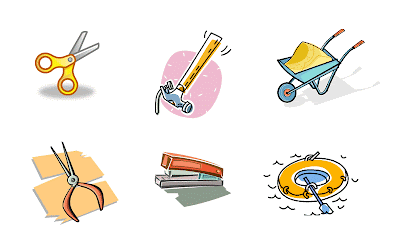
The answers will be posted soon!
First-Class Levers

Levers of the first class are levers in which the fulcrum is located between the load and where the effort is placed. A familiar example is a playground seesaw. The bar that the board rests on is the fulcrum (shown by the red triangle). A child sitting on one side of the seesaw (the blue rectangle) would be the load, and the effort would be measured by how hard it is to push down on the other side to raise the child (at the green arrow). Can you see you the fulcrum is between the load and effort?
Levers are useful because they let us lift heavy objects. You might be able to pick up the child with your arms, if he or she is small enough, but it will be much easier to lift the kid using the seesaw as a lever. What would happen if an adult climbed onto the seesaw instead of the child? Would the effort needed to lift the adult be greater or less? Even though it would be harder to lift the adult than the child, it is still easier to lift the adult with the lever than it would be to lift him or her without!
Here are a couple of free computer games based on first-class levers. (You'll have to watch a short ad first). Give them a try!
Levers are useful because they let us lift heavy objects. You might be able to pick up the child with your arms, if he or she is small enough, but it will be much easier to lift the kid using the seesaw as a lever. What would happen if an adult climbed onto the seesaw instead of the child? Would the effort needed to lift the adult be greater or less? Even though it would be harder to lift the adult than the child, it is still easier to lift the adult with the lever than it would be to lift him or her without!
Here are a couple of free computer games based on first-class levers. (You'll have to watch a short ad first). Give them a try!
Subscribe to:
Posts (Atom)


