Welcome!

Welcome to Dr. B's Science Lab, a non-commercial resource for up-to-date and accurate science content, activities, and projects. Explore a different topic every month, and get the whole family involved in learning and experimenting! Just be sure to follow the directions exactly and pay attention to any safety information given.

If you would like to receive email updates whenever new content is added to Dr. B's Science Lab, submit your address in the "Follow by Email" link at left. Your email address will not be used for any other purpose.


Showing posts with label clock. Show all posts

Wednesday, June 16, 2010

Swing Time!

Pendulum clocks use swinging weights to measure time. They were invented in 1656 CE by the Dutch physicist Christiaan Huygens, and were a big improvement over the other kinds of clocks that were used at that time. You might even have a pendulum clock around your house - many decorative clocks, like grandfather or cuckoo clocks, often use pendulums. If you have to wind the clock, it probably contains a pendulum.

You can do some easy experiment with pendulums and investigate how they measure time.

What you'll need:
Piece of string (about 24 inches or 60 cm long)
Ruler or tape measure
2 heavy metal nuts (from a hardware store)
Tape
Watch with a second hand or other timer

To make your first pendulum, put one end of the string through the hole in the nut and tie a knot. Now you need to find a good spot for your pendulum. You can hang it from a table, shelf or other support. Check with an adult to make sure that it's OK to use tape on your support. Make sure that the pendulum can swing freely without hitting anything. Measure the length of the string. Pull the pendulum back to an angle of about 45o (just estimate; don't worry about measuring) as shown below. Let the pendulum go and time how long it takes to return to the starting position. This time is called the period. If the time is too short, let the pendulum swing three times and divide the total time by three.

OK! Now let's see what effect changing the properties of the pendulum has on the period. First, pull the pendulum back to only about 30o (see figure below) and check the period. Does the pendulum move faster, slower, or at the same speed? Try some other angles!
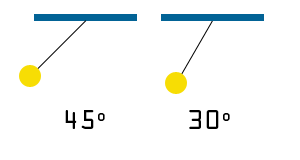

Next, remove the tape and shorten the string to one-half its original length. Measure the period at 45 and 30 degrees. What happens when you shorten the string?

Finally, untie the knot and add a second nut to the string. This makes the pendulum twice as heavy as it originally was. Does the weight affect the period?

Monday, June 14, 2010

Drip! Drip! Drip!

If you built and worked with the sundial from the last post, you realized that this kind of clock is not very good for measuring short times because the sun moves too slowly. Around 1500 BCE, the ancient Egyptians developed the water clock, which used steadily dripping water to tell time. You can make a water clock of your own!

What you'll need:
Empty plastic water or soda bottle
Sharp thumbtack or awl
Clear plastic drinking cup (must hold the same amount of water as the bottle, or more)
Water
Marker
Watch with second hand or other timer

With the thumbtack or awl, carefully make a small hole in the bottom of the bottle (an adult should help with this). Fill the bottle with water and check that water drips out slowly (every few seconds). If it takes too long, make the hole bigger. Empty the bottle.

Place the bottle above the plastic cup so that the water falls into the cup. Make sure that the bottom of the bottle is above the bottom of the cup. Now fill the bottle with water again, and measure how much water collects in the cup after two minutes. Mark the two-minute leve on the plastic cup with a line and a "2". Then measure at 4 minutes, 6 minutes, and so on. If your lines are really close together, then measure at 5-minute intervals instead.

Once your water clock has been marked, you can use it to tell time. Pour the water from the cup back into the bottle and set it up again. But instead of timing how long it takes for a certain amount of water to drip out, use the dripping water to time how long something takes. You might see how long it is between commercials on your favorite TV show, or how long it takes to make some food, or how long you can jump up and down!

Wednesday, June 9, 2010

Tell Time with the Sun

You can make your own sundial very easily. First, you need to scout out a good spot for it. It should be outside, in a location that is lit all day long. Pick your spot, then check it several times during the day to make sure that it is never in shadow from a nearby building, tree, or other large object. The spot should also be somewhere that your sundial won't be disturbed.

When you're ready to make the sundial, take a sheet of white paper and draw a circle about 8" in diameter on it. You might be able to trace around a plate or bowl to draw a nice circle. Place it in your chosen spot. Put a wad of clay or chewing gum in the middle of the circle, then stick an unsharpened pencil or other straight stick into the wad. Make sure that it stands up straight, and doesn't fall over. You should see the shadow of the stick. Make a mark on the circle where you see the shadow, and write the time next to the mark. Come back in another hour or so - the shadow will have moved! Mark the time again. Keep doing this until it gets too dark to see the shadow. Leave the sundial in the same location, and check back the next day at about the same times to see if the shadow is in the same place. How could you use this sundial to tell time? What are some of the problems with a sundial? (Some hints - Does it work at night? Does it work on cloudy days?)

Clockwork

We "tell time" with clocks. Clocks need to use some kind of regular, repeating event to keep time. What kind of event might that be? Lots of different things have been used throughout history, and as the month goes on, you'll get instructions on how to make many of these kinds of clocks!
  • The sun comes up, moves across the sky, then sets every day, so it can be used for a clock. Have you ever seen a sundial in a garden? It uses a shadow cast by the sun to tell time. People have been using sundials for over 2500 years!
  • In water clocks, a stream of dripping water was used to mark off time. They've been around for a few thousand years, too.
  • Around 1200 CE, mechanical clocks began to be used. They were based on some kind of simple machine, like a gear, a spring, or a swinging pendulum. These clocks had to be wound, but they were much more accurate than sundials or water clocks. This kind of clock is still made today - do you know anyone who has one?
  • In the 1920's, scientists figured out how to use crystals of the mineral quartz to measure time. When these crystals are placed in an electric field, they can be made to vibrate steadily. They are much more exact than any earlier type of clock, and are powered by electricity.
  • In 1949, scientists began to use the vibrations of atoms themselves to tell time. The cesium atomic clock is the official clock for the entire world. In the U.S., the official time is broadcast from Fort Collins, Colorado. Devices like portable atomic watches or alarm clocks, or GPS navigation units, can receive this radio signal and make sure that the time they're measuring is correct.